
JOURNAL 3788
Records of Natural Products
Year: 2026 Issue: 3
p.10 - 10
Viewed 223 times.
-
Natale Badalamenti

-
Vincenzo Ilardi
-
Maddalena Cerasola
-
Gianfranco Fontana
-
Francesco Sottile
-
Maurizio Bruno
GRAPHICAL ABSTRACT
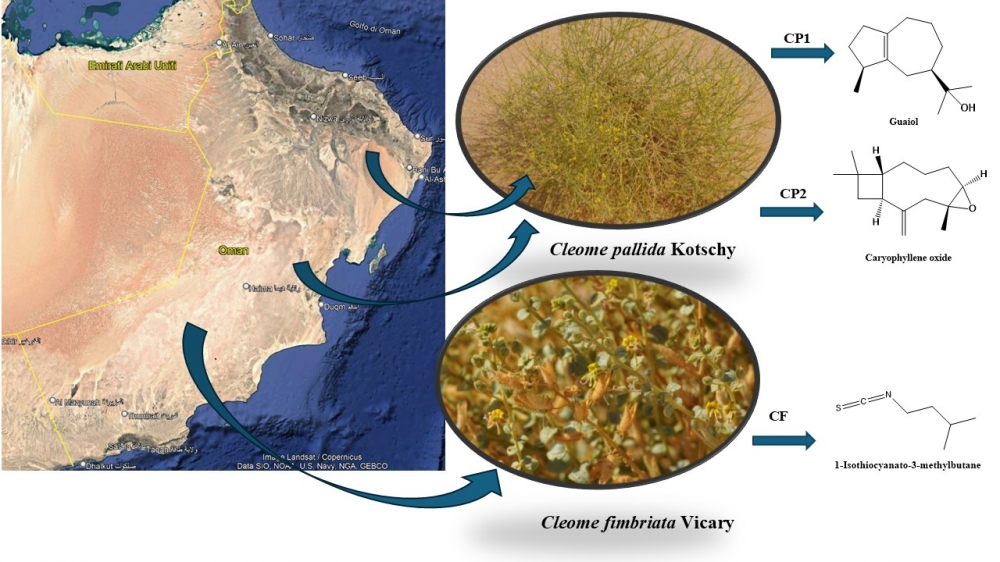
ABSTRACT
Cleome genus, belonging to the Cleomaceae family, includes about 180-199 species distributed in several countries and many of which are used extensively in ethnomedicine. In fact, many of these specimens are consumed in the form of infusions or salads to treat multiple physiological problems. In this study, the qualitative chemical composition of the essential oils obtained by hydrodistillation from Cleome ssp. was studied. Two species, two different accessions (CP1, and CP2) of C. pallida Kotschy, and one of C. fimbriata Vicary (CF), were collected in Oman and chemically investigated for the first time. The three essential oils, extracted by hydrodistillation, were analyzed by gas chromatography and mass spectrometry (GC-MS). In total, 169 compounds were identified. Sesquiterpenoids were found to be the major chemical group of CP1 and CP2 samples (56.4-58.8%); CF, instead, consisted essentially of nitrogen derivatives (30.2%), with 1-isothiocyanato-3-methylbutane (20.7%) as the most abundant class’ compound. Furthermore, a new complete review of the chemical compositions’ literature, never studied, was carried out on all other Cleome species. spontaneous in the world, studied so far. Statistical studies such as Hierarchical cluster (HCA) and principal component analysis (PCA) were employed used to highlightestablish chemo-similarities or dissimilarities, and to highpoint possible correlations between the chemical compositions of CP1, CP2, and CF, and the pharmacognosy and the reported Cleome ssp. essential oils.
KEYWORDS- Caryophyllene oxide
- ecological traits
- food properties
- 1-isothiocyanato-3-methylbutane
- volatile analyses
