
JOURNAL 3730
Journal of Chemical Metrology
Year: 2025 Issue: 2 July-December
p.114 - 127
Viewed 484 times.

GRAPHICAL ABSTRACT
ABSTRACT
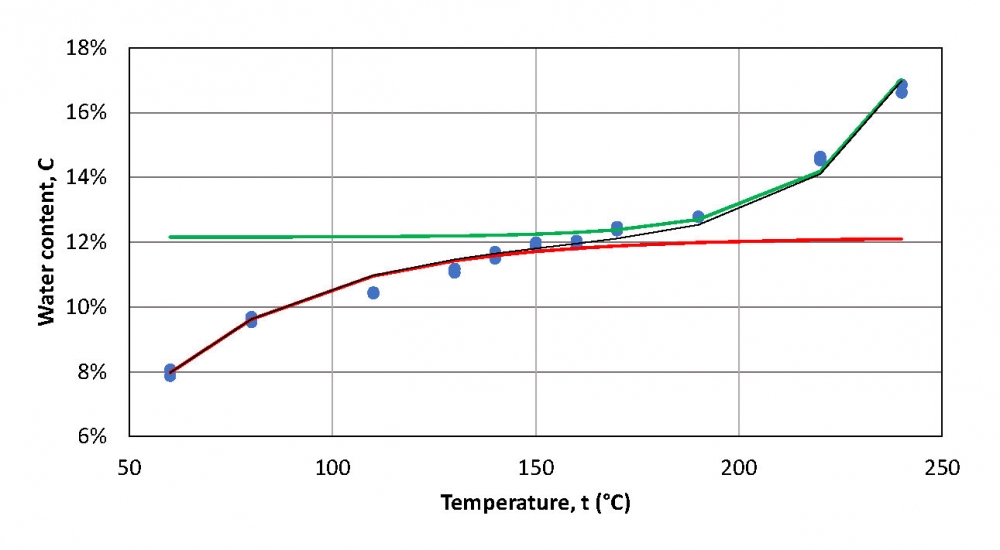
Accurate determination of the water content in plant-derived materials is both crucial and challenging. Most plant-derived materials are not soluble, making conventional coulometric Karl Fischer (KF) titration methods unsuitable for the purpose. The vaporisation–coulometric KF titration (vap-C-KFT) technique offers a more effective alternative for such samples. However, identifying the optimal heating temperature for vaporisation is challenging because at a certain temperature, some components of the material can decompose, while the water released from other components can still be insufficient. In this study, we propose an approach to determine the optimal oven temperature at which insufficient release of water is compensated by the water released due to decomposition, using the vap-C-KFT method. The experimental water content values, depending on KF oven temperature, are approximated by a so-called “sigmoid curve” model that is defined by 5 parameters. This enables to find the optimal analysis temperatures and water content values for different plant-derived materials. The model worked well for barley seeds, wheat seeds, and different types of lignin. However, for crushed rapeseeds the experimental data did not follow the same model, and for non-crushed rapeseeds the water content uncertainty was significantly higher than for other materials.
KEYWORDS- Water content
- vaporisation–coulometric Karl Fischer titration
- wheat
- barley
- lignin
