
JOURNAL 3740
Records of Agricultural and Food Chemistry
Year: 2025 Issue: 2 July-December
p.180 - 192
Viewed 10 times.

GRAPHICAL ABSTRACT
ABSTRACT
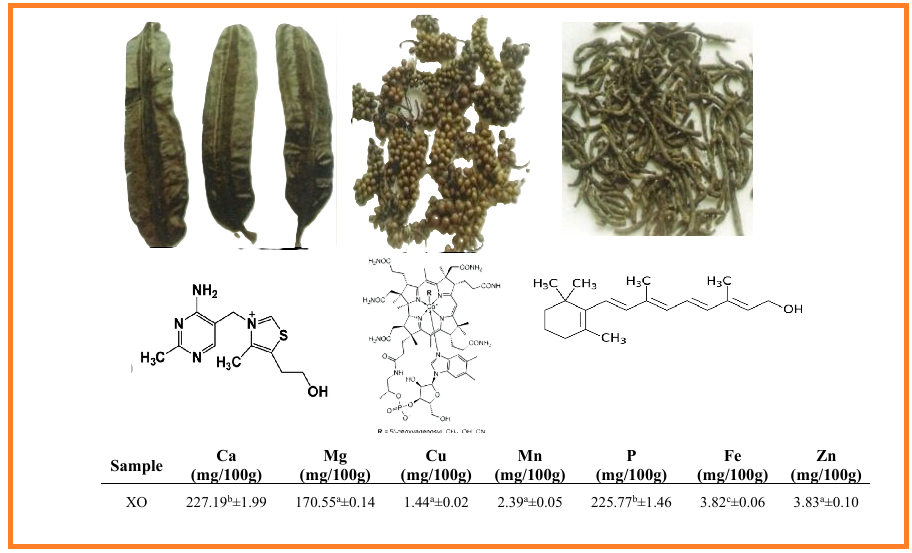
This study evaluated the functional and micronutrients in Piper guineense (uziza), Xylopia aethiopica (Guinea pepper) and Tetrapleura tetraptera (Aidan fruit) spices and also assessed the level of acceptability of the dishes prepared using these spices. The spices were processed before determining the functional, vitamin, mineral and sensory properties. The results show that the oil absorption capacity, foam and gelation capacities of the samples ranged from 1.94 – 2.39%, 13.56 – 10.78 g/mL and 8.45 – 6.00 g/mL respectively. Piper guineense was significantly higher in water absorption capacity (2.27%), bulk density (0.52 mg/100g) and swelling index (1.87 g/mL) while the least values were recorded in Tetrapleura tetraptera for water absorption capacity (2.14 g/mL) and swelling index (1.31 g/mL). Gelatinization temperature ranged between 58.73oC (Tetrapleura tetraptera) and 62.45oC (Xylopia aethiopica). Piper guineense was higher in Calcium (283.72 mg/100g), Phosphorus (249.96 mg/100g) and Iron (6.34 mg/100g). Tetrapleura tetraptera had the lowest values for Calcium (189.01 mg/100g), Magnesium (144.90 mg/100g), Copper (0.13 mg/100g), Manganese (0.84 mg/100g), Phosphorus (196.49 mg/100g) and Zinc (1.27 mg/100g), while sample Xylopia aethiopica had the least value for Fe (3.82 mg/100g) and higher values for Magnesium (170.55 mg/100g), Copper (1.44 mg/100g), Manganese (2.39 mg/100g) and Zinc (3.83 mg/100g). The vitamin B1 content of the samples ranged from 0.02 (Piper guineense) – 0.03 (Xylopia aethiopica and Tetrapleura tetraptera) mg/100g. The vitamin B2 content of samples ranged from 0.02 – 0.03 mg/100g. The vitamin B12 content of the samples ranged from 0.28 (Piper guineense) – 0.33 (Xylopia aethiopica) mg/100g. The vitamin C content of Piper guineense (1.84 mg/100g) was higher than other samples. The vitamins A and E contents ranged from 8.27 – 9.58 µg/100g and 0.85 – 1.72 mg/100g respectively. Tetrapleura tetraptera was highest while Xylopia aethiopica was the lowest. There were variations in the sensory score of the dishes prepared with theses spices.
KEYWORDS
- Spices
- Piper guineense
- Xylopia aethiopica
- sensory evaluation
- traditional Nigerian foods
