
Records of Natural Products
A scientific open access journal in the field of natural products.

LATEST ARTICLES
Nicocembranoside A: A new neuroprotective cembrane glycoside from Nicotiana tabacum L.
 ,
Bao-Min Lin
,
Ping-Zhang Yao
,
Cui-Ling Chen
,
Miao Liang
,
Ya-Ke Luo
,
Pengfei Yang
and
Jun-Ping Gu
,
Bao-Min Lin
,
Ping-Zhang Yao
,
Cui-Ling Chen
,
Miao Liang
,
Ya-Ke Luo
,
Pengfei Yang
and
Jun-Ping Gu
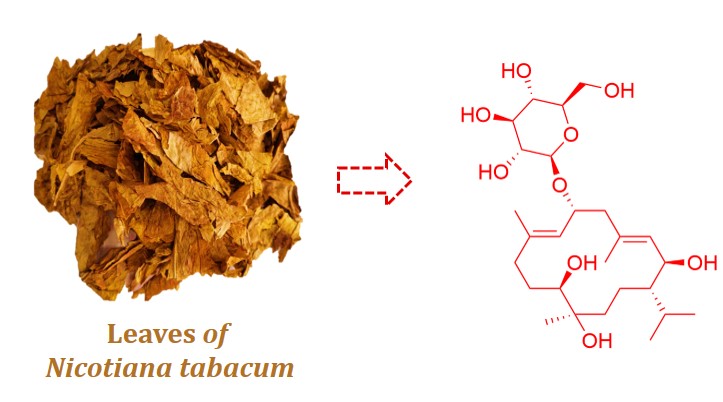
Cembrane-type diterpenoids are recognized for their medicinal significance.The phytochemical investigation of Nicotiana tabacum L. led to the isolation of Nicocembranoside A (1), a novel cembrane glycoside, represents the ninth naturally occurring cembrane glycoside and the first isolated from N. tabacum leaves. The structure of 1 was elucidated through comprehensive spectroscopic analyses, including 1D (1H, 13C NMR) and 2D NMR (COSY, HSQC, HMBC, ROESY), complemented by HRESIMS and biosynthetic precedence. Additionally, seven known compounds were also isolated and characterized. Preliminary evaluation demonstrated 1 exhibits neuroprotective effect against glutamate-induced cytotoxicity
in PC12 cells at 10 μM.
Two new compounds from the leaves of Forsythia suspensa (Thunb.) Vahl
,
Yuxuan Wang
,
Jingjing Su
,
Dongdong Zhang
and
Xuan Zhang
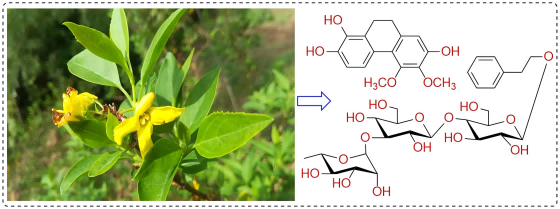
A new phenanthrene derivative and a new phenylethanoid glycoside were isolated from Forsythia suspensa (Thunb.) Vahl leaves, named as 5,6-dimethoxy-9,10-dihydrophenanthrene- 1,2,7-triol (1), phenethyl alcohol 8-O-α-L-rhamnopyranosyl-(1→3)-O-β-D- glucopyranosyl-(1→4)-O-β-D-glucopyranoside (2). These structures were determined by analysing their physical and chemical properties and using high-resolution mass spectrometry, infrared spectroscopy, nuclear magnetic resonance and other spectroscopic techniques. In addition, the toxic activity of the isolated compounds on RAW 264.7 cells was evaluated, but the isolated compounds did not show significant activity.
DOI http://doi.org/10.25135/rnp.2511.3726 Keywords Forsythia suspensa (Thunb.) Vahl phenylethanoid glycoside phenanthrene derivative DETAILS PDF OF ARTICLE © 2026 ACG Publications. All rights reserved.Penioxalone A: A new isocoumarine derivative fromPenicillium oxalicum with potent cytotoxic effects on A549 cells
,
Yimeng Li
,
Siyu Liu
,
Jing Ren
,
Jian Wang
and
Wenbin Gao
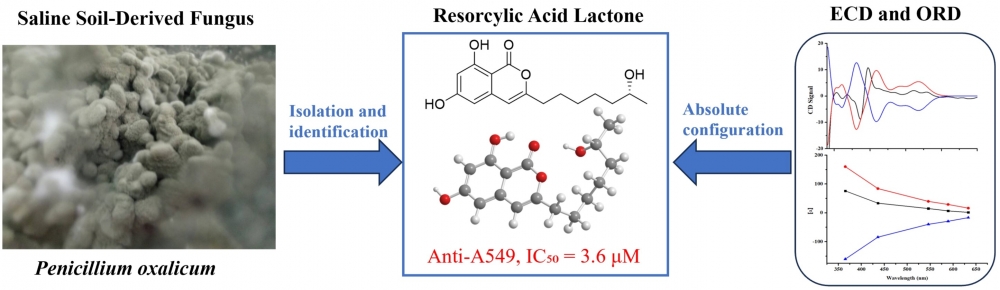
A chemical analysis of Penicillium oxalicum, a fungus isolated from saline soil, resulted in the discovery of four bioactive compounds (1–4), including a new resorcylic acid lactone, named penioxalone A (1). The structural characterization of penioxalone A was achieved through comprehensive spectroscopic techniques, including 1D and 2D NMR spectroscopy, coupled with HRESIMS data. To determine its absolute configuration, experimental data from ECD and ORD were compared with theoretical calculations. The cytotoxicity of compounds 1, 3, and 4 was assessed against A549 human lung carcinoma cells, revealing IC₅₀ values of 3.6, 0.23, and 0.35 μM, respectively. These compounds exhibited enhanced potency compared to cisplatin, a standard chemotherapy drug, which had an IC₅₀ of 4.2 μM.
DOI http://doi.org/10.25135/rnp.2511.3716 Keywords Fungus Penicillium oxalicum penioxalone A resorcylic acid lactone cytotoxic activity DETAILS PDF OF ARTICLE © 2026 ACG Publications. All rights reserved.Bioactive compounds from the flowers of Cannabis sativa L.: Isolation of a new alkaloid and biological evaluation of cannabinoids and sesquiterpenoids
,
Sunhyeong Choi
,
Hongda Yun
,
Youngmi Lee
,
Chulmin Kim
,
Seojeong Oh
,
Mansoo Cho
,
Eunsol Lee
,
Jungwon Seo
and
Hyun Ju Jung
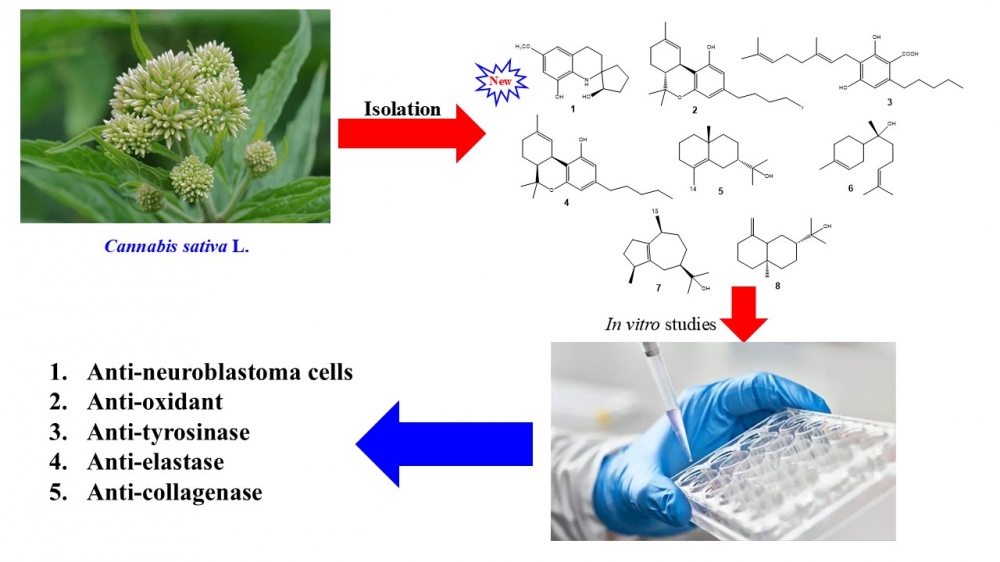
Cannabis sativa L. is a significant plant widely used for both medicinal and recreational purposes. Previous studies have reported that the secondary metabolites of this plant continue to play a crucial role in drug research and development. This study aims to investigate bioactive compounds in the n-hexane fraction obtained from the ethanolic extract of C. sativa flowers. The isolation yielded eight compounds (1-8), including one new compound (1). Their chemical structures were elucidated by 1D and 2D NMR, HR-ESI-MS, and comparisons with previously reported data. The results of the preliminary biological evaluation revealed that compounds 2-4 and 8 suppressed the proliferation of SK-N-SH cells at 10 μM. Notably, compound 4 displayed the strongest activity, with an IC50 value of 22.53 ± 1.92 μM, suggesting its potential as a candidate for the development of neuroblastoma cell proliferation inhibitors. In addition, compounds 1-8 were also evaluated for antioxidant, tyrosinase, elastase, and collagenase inhibitory activities. Among them, compound 1 showed the highest antioxidant activity, inhibiting 50.89% at 100 μM, compared with ascorbic acid. Compounds 1-3 and 6-8 also demonstrated elastase inhibitory activity, with inhibition rates ranking from 49.95% to 56.68% at 1 mM, relative to oleanic acid as a positive control. Similarly, compounds 1, 3, and 5 inhibited collagenase, with inhibition rates ranging from 55.34% to 73.17% relative to EGCG as a positive control. However, all compounds displayed relatively weak tyrosinase inhibitory effects, with inhibition ranging from 5.22% to 31.02%. This study also represents the first published evaluation of the inhibitory activities of isolated compounds from C. sativa flowers against tyrosinase, elastase, and collagenase.
DOI http://doi.org/10.25135/rnp.2509.3648 Keywords Cannabis sativa cannabinoids SK-N-SH cells tyrosinase elastase collagenase DETAILS PDF OF ARTICLE © 2026 ACG Publications. All rights reserved.