
Records of Agricultural and Food Chemistry
Year: 2026 Volume: 6 Issue:1
1) Antioxidant, anticholinesterase, and tyrosinase enzyme inhibitory profiles of nine Saudi honeys revealed by multivariate analysis
 ,
Hassan Elwaday
,
Abdalla Almarhabi
,
Sakina Yagi
,
Ezzat Mohamed
,
Mohamed Elamin
and
Gökhan Zengin
,
Hassan Elwaday
,
Abdalla Almarhabi
,
Sakina Yagi
,
Ezzat Mohamed
,
Mohamed Elamin
and
Gökhan Zengin
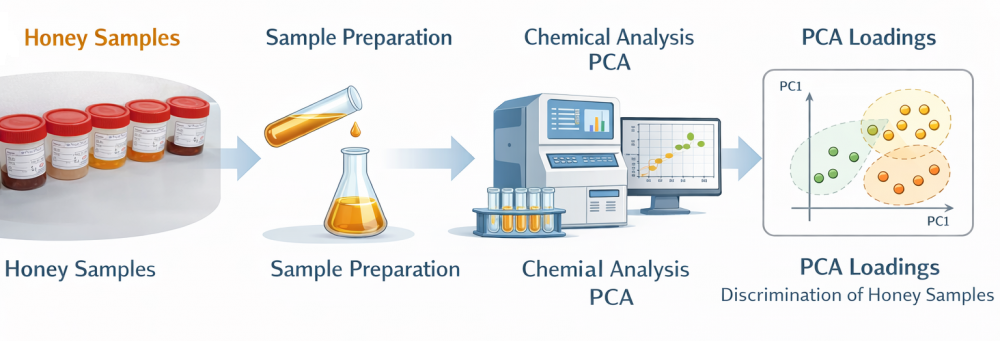
Honey is well known for its nutritional and therapeutic potential since ancient time. The current study was designed to investigate the chemical composition, antioxidant and enzyme inhibitory activities of nine Saudi honey types. Three extracts, ethanol, methanol and aqueous, were prepared from each type. Results of fructose, glucose, sucrose and 5-hydroxymethylfurfural contents in the tested Saudi honey types indicated their good quality with the honeyofSider Bisha and Sider Albaha occupied the highest position. Polar extracts of honey recorded the highest TPC and TFCvalues and the best values were recorded from the aqueous extract of Sider Bisha (197.67 mg GAE/100 g) and Talh Hail (67.45 mg RE/100 g) respectively. All honey extracts showed significant antioxidant activity and the MeOH extract of Sider Bisha displayed the highest anti-ABTS (809.42 mg TE/g) and chelating (98.71 mg EDTAE/g) properties and that of Sumra Bisha recorded the best anti-DPPH activity (30.67 mg TE/g). The aqueous extract of the latter and that of Talh Hail revealed the best Fe++ (248.41 mg TE/g) and Cu++ (256.72 mg TE/g) reducing capacity. All honey types exerted remarkable enzyme inhibitory activity; all extracts of Sumra Bisha, EtOH and aqueous extracts of Sider BishaandSiderTehamhandMajraaswellasaqueousextractofTalhTehamhandMeOHextractofTalhHailexerted remarkable anti-acetylcholinesterase effect (9.64–10.23 mg GALAE/g; p ≥ 0.05) while aqueous extract of Sumra Bisha andSiderAlbahaexhibitedthehighestanti-butyrylcholinesteraseeffect(16.46and15.13mgGALAE/g;p≥0.05).MeOH extract of Qatada honey recorded the highest anti-Tyr effect (260.95 mg KAE/g). These findings indicated that the nine Saudi honey types are of good quality, high bioactive molecules and could play a significant role in oxidative stress.
DOI http://doi.org/10.25135/rfac.2601.3790 Keywords Saudi honey sugar 5-hydroxymethylfurfural total phenol antioxidant enzyme inhibition DETAILS PDF OF ARTICLE © 2026 ACG Publications. All rights reserved.2) Effect of lactic acid bacteria fermentation and tigernut supplementation on the nutritional quality and microbial safety of Kunun zaki beverage
,
Olusegun Ayodele Olaoye
and
AnthonyNwankwo Ukom
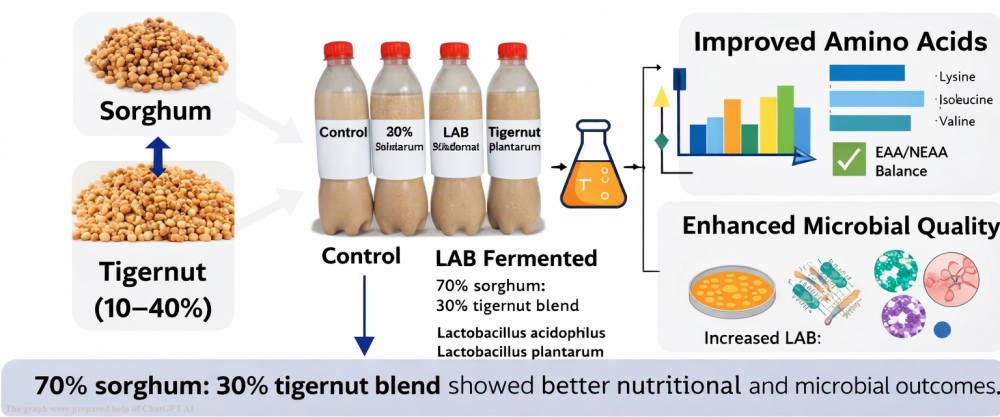
Kunun zaki is a traditional cereal-based fermented beverage widely consumed in West Africa; however, its nutritional quality and microbiological stability are often limited due to spontaneous fermentation. This study investigated the effects of controlled fermentation using defined lactic acid bacteria (LAB; Lactobacillus acidophilus and Lactobacillus plantarum) combined with graded tigernut supplementation (10–40%) on the amino acid composition and microbial quality of sorghum-based kunun zaki beverage. Five formulations were produced: a spontaneously fermented 100% sorghum (control) and four LAB-inoculated sorghum-tigernut blends. Amino acid profiles were determined and microbiological quality was assessed during 72 h of storage. Controlled LAB fermentation significantly improved the essential amino acid profile of kunun zaki, with notable increases in lysine, isoleucine, and valine in tigernut-enriched formulations (p < 0.05), indicating enhanced protein quality. Tigernut supplementation contributed to compositional complementation, further increasing essential amino acid density without disrupting the EAA/NEAA balance. LAB-fermented samples exhibited sustained LAB dominance (>5.5 log10 CFU/mL), absence or minimal detection of coliforms and fungi and improved microbial stability compared with the control during storage. Among the formulations, the 70% sorghum: 30% tigernut blend demonstrated the most balanced nutritional and microbiological profile. These findings demonstrate that integration of defined LAB starter cultures with optimized tigernut inclusion represents an effective biotechnology strategy for enhancing the nutritional value, microbial safety and storage stability of kunun zaki, thereby supporting its development as an improved functional beverage with commercialization potential.
DOI http://doi.org/10.25135/rafc.2601.3793 Keywords Kunun zaki lactic acid bacteria tigernut amino acid DETAILS PDF OF ARTICLE © 2026 ACG Publications. All rights reserved.